Caution! This message was sent from outside the University of Manitoba.
This was the Globe and Mail's editorial yesterday:
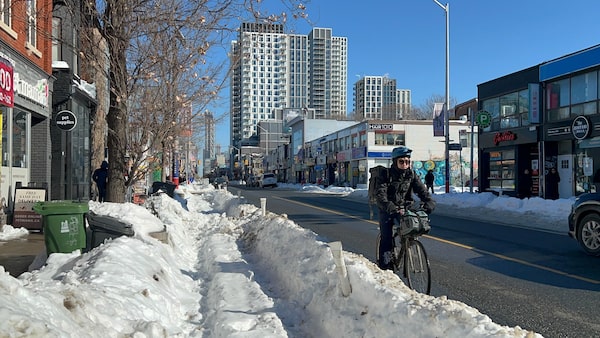
The slippery politics of snow removal The Editorial Board Published Yesterday Open this photo in gallery:https://www.theglobeandmail.com/resizer/v2/5VLMW5TCONDQVN2E5VJLBVF5Y4.JPG?auth=afe3b595eba8d9bdbca60bba7c356d210d07f759421786b392852411103dbba8&width=600&height=400&quality=80&smart=true [cid:image001.jpg@01DC95C0.B1A6A460]https://www.theglobeandmail.com/resizer/v2/5VLMW5TCONDQVN2E5VJLBVF5Y4.JPG?auth=afe3b595eba8d9bdbca60bba7c356d210d07f759421786b392852411103dbba8&width=600&height=400&quality=80&smart=true
Bike lanes running along Toronto's Bloor Street remain blocked on Sunday, Feb. 1, a week after the city received a historic dump of snow. Kathryn Mannie/The Canadian Press 189 Commentshttps://www.theglobeandmail.com/opinion/editorials/article-the-slippery-politics-of-snow-removal/#comments After a recent snowstorm hit Southern Ontario, an obvious pecking order revealed itself in Toronto. The roads were clear enough within days that drivers could move around at will. But people on foot or bike were left to fight through uncleared snow for more than a week. This was not the first time the city has struggled to deal with the aftermath of a storm. Who could forget former Toronto mayor Mel Lastman calling in the army and making the city butt of a national joke? But snow removal is no laughing matter. Delays in clearing can leave people trapped at home, or put them in dangerous situations. Doing it right is one of the fundamental responsibilities of local government. Snow clearing is also a matter of political choices. It's understandable that no city will have enough equipment and personnel to dig out immediately after an atypical snowstorm. The roughly 50 centimetres that fell on Toronto late in January was the snowiest single day on record. So choices have to be made, priorities determined. The choice not to clear many sidewalks and bike lanes is one Mayor Olivia Chow must wear. Something failed here. If the policy is the problem, change the policy. If crews are shirking, light a fire under them. If the snow-removal contracts Ms. Chow inherited are flawed, renegotiate them. Toronto is still digging out of a record-breaking dump of snowhttps://www.theglobeandmail.com/canada/article-toronto-is-still-digging-out-of-a-record-breaking-dump-of-snow/ Frustratingly, Toronto also fell down on the jobhttps://www.theglobeandmail.com/opinion/editorials/article-toronto-falls-down-on-snow-removal/ of clearing sidewalks promptly after another storm, less than a year ago. Was nothing learned? This pattern breaks the deal the city made with residents. Toronto pushes much of its growth to a small number of areas, which puts a premium on sidewalk space there. As well, the city no longer requires new developments to include parking spots. The logic is that local roads can't absorb more traffic, so many new residents will opt to walk or ride bicycles. However, Toronto is not living up to its side of the bargain: providing safe spaces for active transportation. Clearing snow is, like picking up garbage or running transit or keeping water fountains flowing, among the key tasks of big-city government. Doing these well is table stakes for urban life, allowing people to spend their time, safely and pleasantly, out in public. More stories below advertisement Before the rest of the country snickers too much at Toronto's winter woes, these are tests more easily aimed at than achieved. Snow clearing is a perennial complaint in cities across Canada. In many cases, people are right to complain. This is not kvetching, this is demanding competence. Without proper snow clearing, people can't get around. And it's illustrative to note just who gets left behind. Uncleared snow can result in disabled people being unable to leave home. Anyone with a stroller or a cart faces tough slogging. Cyclists are forced into traffic with motor vehicles, a dangerous scenario the city has spent tens of millions of dollars building infrastructure to prevent. Delivery riders risk their lives to bring food. This is unacceptable, particularly for a city as obsessed with equity as Toronto. Digging out? How to minimize the toll shovelling snow takes on your bodyhttps://www.theglobeandmail.com/life/advice/article-shovelling-snow-how-to-avoid-injury/ With the city missing in action after the storm, many Torontonians stepped up to clear the sidewalk in front of their home. That's to be commended. But that it fell to them illustrates the inequity at play. The city wouldn't dream of relying on residents to shovel the road. Adding to the insult, the city gaslit its residents. There are examples of people complaining about a particular stretch of uncleared snow and being told that it had been taken care of, although it hadn't been. This recalls dishonesty after the storm last winter, when the city claimed sidewalks had been plowed while simple observation showed they hadn't. There was also policy incoherence. Some transit stops were cleared by moving the snow to an adjacent bicycle lane. Curb-lane parking spots on residential streets were being cleared out before all sidewalks were properly plowed. The approach must be rethought before the next storm. The first priority should be to ensure roads are clear enough for emergency vehicles to get through. Beyond that, deploy resources so that no manner of getting around is disadvantaged. Or, better yet, make the political choice to tackle snow removal more aggressively on sidewalks and bicycle lanes than roads. Cars can be mounted with snow tires but people can't, leaving them more vulnerable to winter conditions.
https://www.theglobeandmail.com/opinion/editorials/article-the-slippery-poli...