Caution! This message was sent from outside the University of Manitoba.
https://www.theglobeandmail.com/authors/rob-carrick/ [Rob Carrick]https://www.theglobeandmail.com/authors/rob-carrick/
Rob Carrickhttps://www.theglobeandmail.com/authors/rob-carrick/Personal Finance Columnist Special to The Globe and Mail Published 10 hours agoUpdated 4 hours ago Open this photo in gallery:https://www.theglobeandmail.com/resizer/v2/B5LSGINOJVB4RD7MRSJ3BTB644.JPG?auth=6dc5c32be0f82c2d505c96038d1cdf6217200877b87cb76f7cb9d090766137c7&width=600&height=400&quality=80&smart=true [cid:image002.jpg@01DC691F.50427EB0]https://www.theglobeandmail.com/resizer/v2/B5LSGINOJVB4RD7MRSJ3BTB644.JPG?auth=6dc5c32be0f82c2d505c96038d1cdf6217200877b87cb76f7cb9d090766137c7&width=600&height=400&quality=80&smart=true
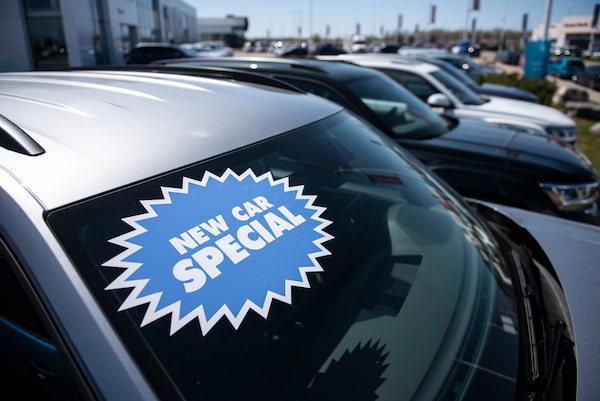
High payments for new vehicles can kill cash flow.Justin Tang/The Canadian Press 450 Commentshttps://www.theglobeandmail.com/investing/personal-finance/article-new-vehicle-car-great-canadian-money-suck-financial-advice/#comments The triangle of sadness in personal finance is houses, groceries and vehicles. Nothing in the outlook for 2026 suggests major relief is coming on any of those fronts, which leaves you to take action yourself. After five years of oppressive inflation, you've likely pared down your grocery spending as much as possible. Selling your home to cut living costs is no real option, either; it's a last resort and opens up a new set of problems. This leaves us with new vehicles, the Great Canadian Money Suck. The average new vehicle selling price was almost $45,000 at mid-year, and the average monthly loan payment was around $850, according to J.D. Power. Canadians have been amazingly open to carrying this load, but there are signs that is changing. Looking back over his 16 years as a bankruptcy trustee, Scott Terrio recalls how normal it was to point out to clients that high payments for a new vehicle were killing their cash flow. With monthly payments over $1,000, auto loans are increasingly like car mortgageshttps://www.theglobeandmail.com/investing/personal-finance/article-car-auto-loan-mortgage-monthly-payment-finance-budget/ "The difference now is that I have spoken to at least five or six people who have actively said to me, before I suggested it, that they'd like to give their car back," said Mr. Terrio, the manager of consumer insolvency at Hoyes Michalos & Associates. "And that's never happened." You can see the burden of vehicle payments in the latest numbers from credit reporting agency Equifax. In the third quarter of this year, the number of borrowers who missed three or more payments on their auto loans increased 10.8 per cent, to a total of 1.9 per cent of borrowers. Mr. Terrio lays out the savings of getting rid of a car as follows: A monthly payment of, let's say, $700, plus $300 for insurance and another $300 for gas. "That's $1,300 per month - what other lever in your budget can you pull with that extent of savings?" he said. "Nothing. It's so glaring." Let me preface the coming rant on vehicle spending by saying that I have owned 16 cars and one SUV in the past 47 years. I have economized and overspent on vehicles, mostly new ones because I appreciate the improvements in performance, fuel consumption, safety and comfort. In my early 30s, having just bought a home, I sold a fairly expensive two-seat sports car to clear some space in our household spending. One vehicle-buying rule I always followed was to limit loan terms to five years rather than give in to six- and seven-year terms that would shrink monthly payments. Another rule was to put a $400 ceiling on monthly payments, which I'll now inflate to $500 to reflect higher vehicle prices. More stories below advertisement The unspoken consensus that it's fine to pay hundreds of dollars more per month for a vehicle was partly built on clever marketing by the auto industry, which got us hooked on higher-cost SUVs over cars. To ease the shock of higher costs, dealers and lenders commonly offer loan terms of up to seven or eight years and present financing deals by showing weekly or biweekly payments instead of monthly ones. Another explanation for our acceptance of high vehicle payments is that we're more than ever using cars and SUVs to manifest our best selves. Driving a fully loaded SUV says we're active people with busy lives who appreciate finer things. Mr. Terrio sees vehicles as a classic example of the conflict between needs and wants. "People will say to me, 'But I need my car,' and I say back to them, 'You need a car - you don't need that car.'" Rob Carrick: Four questions to help you navigate the personal finance challenges aheadhttps://www.theglobeandmail.com/investing/personal-finance/article-personal-finance-challenges-economy-advice-budget/ Rob Carrick: Eight lessons learned in 27 years of covering personal finance and investinghttps://www.theglobeandmail.com/investing/personal-finance/article-rob-carrick-eight-lessons-learned/ The types of vehicles his clients drive is worth noting. Expensive German brands are common. Also, some Teslas and fully loaded pickup trucks owned by young men. Mr. Terrio noted how common it is for renters to own vehicles like these - he's heard a theory that people are buying luxury vehicles as consolation for being shut out of the housing market. The reason why we may be at a breaking point for the acceptance of high vehicle costs is the layering of generational levels of inflation on top of economic disruptions caused by the pandemic and then the trade war with the United States. If you're under maximum financial stress and see your car or SUV payments as part of the problem, Mr. Terrio says you can notify the lender or dealer that you're walking away from your loan. Any shortfall between the sale proceeds for your vehicle and the amount owing can be added to the debts that are part of your insolvency. Mr. Terrio believes Canada is "over-vehicled," which is to say we spend too much on cars and SUVs relative to income. "I'm not anti-car," he said. "I'm anti-broke."